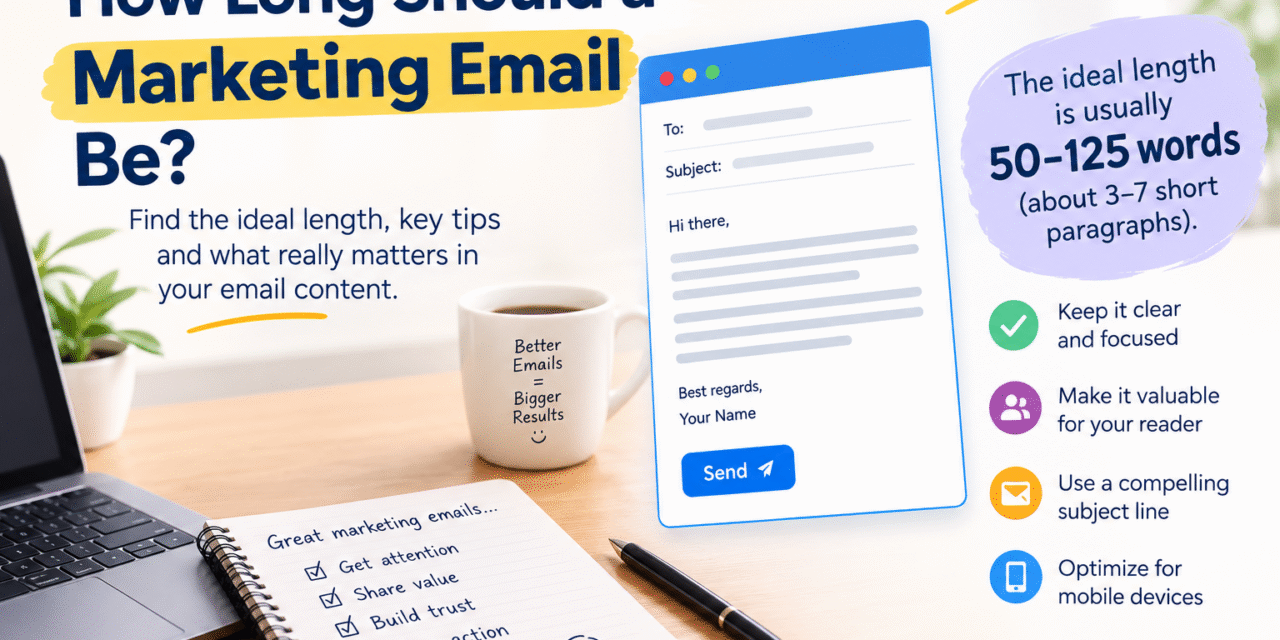
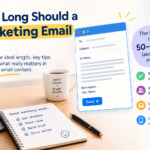
If you’ve ever stared at a half-written email wondering whether to keep going or wrap it up, you’re not alone. How long should a marketing email be is one of the most common questions marketers ask, and the honest answer is: it depends on your goal, audience, and message — but data gives us a strong starting point. Most high-performing marketing emails run 50-200 words for promotional content, while newsletters and educational emails can run 300–500 words or more.
Let’s break down what actually works and why.
Why Email Length Matters
People skim. The average person spends only a few seconds deciding whether to keep reading an email or delete it. That means every sentence has to earn its place. Answering how long should a marketing email be isn’t about hitting an arbitrary word count — it’s about respecting your reader’s time while still delivering enough value to prompt action.
Too short, and you risk leaving out the context or benefit that convinces someone to click. Too long, and you lose readers before they reach your call to action.
Ideal Length by Email Type
Not all marketing emails serve the same purpose, so length should flex accordingly.
Promotional emails (50–125 words)
If you’re announcing a sale, product launch, or limited-time offer, brevity wins. These emails work best when they get straight to the point: what’s the offer, why should the reader care, and what should they do next. A clear subject line plus a short, punchy body with one strong CTA typically outperforms a wordy pitch.
If you’re announcing a sale, product launch, or limited-time offer, brevity wins. These emails work best when they get straight to the point: what’s the offer, why should the reader care, and what should they do next. A clear subject line plus a short, punchy body with one strong CTA typically outperforms a wordy pitch.
Newsletter emails (300–500 words)
Newsletters are meant to inform, entertain, or build relationships over time. Readers who open a newsletter usually expect more substance, so a longer format is appropriate here. Still, break content into scannable sections with subheadings, bullet points, and short paragraphs.
Newsletters are meant to inform, entertain, or build relationships over time. Readers who open a newsletter usually expect more substance, so a longer format is appropriate here. Still, break content into scannable sections with subheadings, bullet points, and short paragraphs.
Nurture or drip campaign emails (100–200 words)
These emails guide a subscriber through a journey, so they should feel conversational and focused on a single idea per message rather than trying to cover everything at once.
These emails guide a subscriber through a journey, so they should feel conversational and focused on a single idea per message rather than trying to cover everything at once.
Cold outreach or sales emails (75–150 words)
Brevity signals respect for the recipient’s time and increases the chance your message gets read in full rather than skimmed and archived.
Brevity signals respect for the recipient’s time and increases the chance your message gets read in full rather than skimmed and archived.
Factors That Influence Optimal Length
There’s no universal rule for how long should a marketing email be, but several factors help you calibrate:
- Audience familiarity: Cold prospects need less text and more clarity; warm subscribers can handle more detail.
- Device usage: Most emails are opened on mobile, so shorter paragraphs and fewer words per line improve readability.
- Goal of the email: A single CTA email should be tight; an educational piece can be longer if it delivers real value.
- Industry norms: B2B audiences often tolerate longer, more detailed emails than B2C audiences who expect quick, visual content.
Tips for Keeping Emails Tight and Effective
- Lead with the value, not the backstory. Get to the point in the first two lines.
- Use one CTA per email whenever possible — multiple asks dilute focus.
- Break up text with short paragraphs, bullets, and white space so the email feels scannable, not dense.
- Cut ruthlessly during editing. If a sentence doesn’t support your main message, remove it.
- Test length with your own list. Benchmarks are useful starting points, but your specific audience’s engagement data is the real source of truth.
Final Thoughts
So, how long should a marketing email be? As a rule of thumb, keep promotional and sales emails short and focused (50–150 words), and let newsletters or educational content stretch a bit longer (300–500 words) when the value justifies it. The right length ultimately depends on your audience and objective — but in nearly every case, clarity and brevity beat length. Write only as much as you need to make your point and prompt action, then stop.
.










Your writing style is so engaging and easy to read It makes it a pleasure to read your blog and…
I was more than happy to search out this net-site.I needed to thanks for your time for this excellent learn!!…
Usually I do not read article on blogs, but I would like to say that this write-up very compelled me…
Hello, i believe that i noticed you visited my website thus i came to “return the choose”.I'm attempting to find…
Thanks for sharing. I read many of your blog posts, cool, your blog is very good.