How Many Types of Email Marketing Are There? A Complete Guide
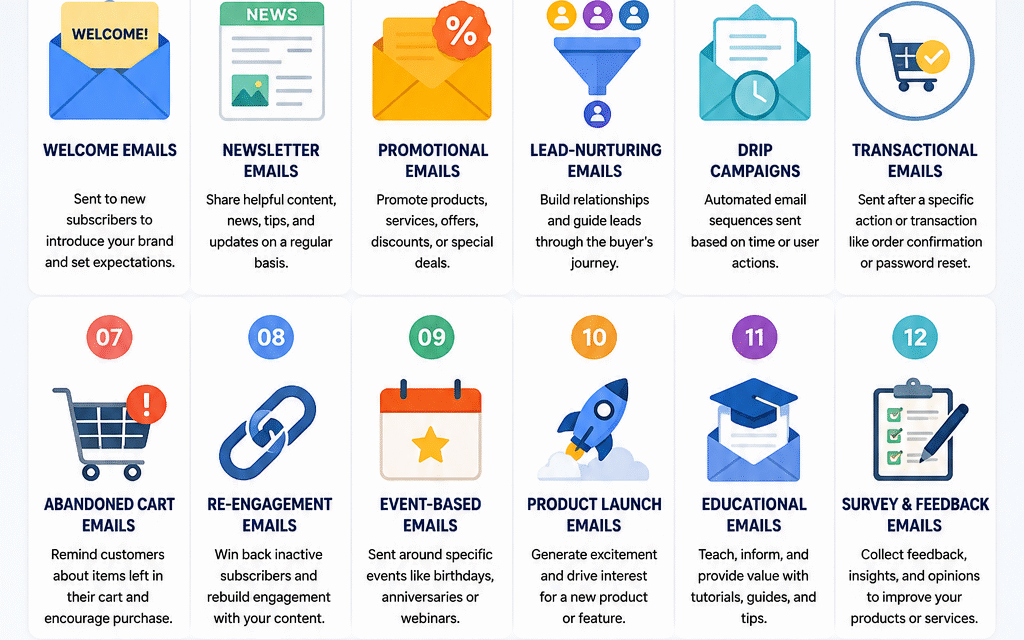
If you are wondering how many types of email marketing there are, the answer depends on how you classify campaigns. In practice, businesses use several major email marketing formats, including newsletters, promotional emails, welcome emails, lead-nurturing emails, transactional emails, automated emails, re-engagement campaigns, and event-based emails. Each type has a different purpose, and understanding when to use each one can help you build more effective email campaigns.
Email marketing is one of the most useful digital marketing channels because it allows businesses to communicate directly with people who have voluntarily provided their email addresses. Instead of relying entirely on social media algorithms or paid advertising, businesses can build an owned audience and communicate with subscribers regularly.
Email marketing is the process of using email to communicate with customers, prospects, subscribers, or other members of an audience.
Businesses use email marketing for several purposes, such as:
- Building relationships with subscribers
- Promoting products and services
- Generating leads
- Increasing website traffic
- Educating potential customers
- Nurturing prospects
- Increasing sales
- Retaining existing customers
- Re-engaging inactive subscribers
- Delivering important customer information
A successful email marketing strategy usually combines several campaign types rather than depending on one type of email.
- Welcome Emails
A welcome email is sent shortly after someone subscribes to an email list, creates an account, downloads a lead magnet, or makes a first interaction with a business.
The welcome email creates the first direct communication between the company and the subscriber, making it an important part of the customer journey.
What can a welcome email include?
A welcome email can:
- Thank the subscriber
- Introduce the business
- Explain what subscribers can expect
- Deliver a lead magnet
- Provide useful resources
- Introduce products or services
- Encourage subscribers to follow social media accounts
- Direct subscribers to important website pages
Example
A digital marketing blog might send:
Welcome to our email marketing community! Every week, you’ll receive practical tips about SEO, email marketing, content marketing, and digital advertising.
A strong welcome email should provide value instead of immediately pushing a sales message.
- Newsletter Emails
Newsletters are regularly scheduled emails containing useful information for subscribers.
They may be sent weekly, biweekly, or monthly.
A newsletter can contain:
- Blog articles
- Industry news
- Tips and tutorials
- Case studies
- Product updates
- Curated resources
- Company announcements
- Educational content
For example, an SEO blog could send a weekly newsletter containing new SEO articles, keyword research tips, Google updates, and recommended tools.
The key objective is to consistently provide value so subscribers look forward to receiving future emails.
- Promotional Emails
Promotional emails are designed primarily to encourage subscribers to take a commercial action.
They are commonly used for:
- Product launches
- Discounts
- Special offers
- Seasonal sales
- Limited-time deals
- Coupons
- Free trials
- Service promotions
- Upselling and cross-selling
For example:
Subject: Get 30% Off Our SEO Course This Week
The email could explain the offer, highlight the benefits of the course, and include a clear call-to-action such as Enroll Now.
Promotional emails can generate direct revenue, but sending too many sales-focused emails may cause subscribers to lose interest or unsubscribe.
- Lead-Nurturing Emails
Not every person who joins your email list is ready to purchase immediately.
Lead-nurturing emails help move prospects through the buying journey by providing relevant information over time.
For example, someone downloads an ebook called The Beginner’s Guide to SEO.
You could create a sequence such as:
Email 1: Deliver the ebook
Email 2: Explain basic SEO concepts
Email 3: Introduce keyword research
Email 4: Explain on-page SEO
Email 5: Share an SEO case study
Email 6: Introduce your SEO service
This approach builds trust before asking for a purchase.
- Drip Campaigns
A drip campaign is a series of emails sent automatically according to a predefined schedule or subscriber behavior.
For example:
- Day 1: Welcome email
- Day 2: Educational article
- Day 4: Useful resource
- Day 7: Case study
- Day 10: Product introduction
- Day 14: Special offer
Drip campaigns are particularly useful for lead nurturing, onboarding, education, and sales funnels.
The major advantage is automation. Once the campaign has been properly configured, emails can be delivered automatically to subscribers.
- Transactional Emails
Transactional emails are triggered by a specific action or transaction.
Examples include:
- Order confirmation
- Payment confirmation
- Shipping notification
- Password reset
- Account creation
- Invoice notification
- Booking confirmation
- Cancellation confirmation
These emails are different from traditional promotional emails because their primary purpose is to provide information related to a transaction or account activity.
For an ecommerce business, a typical sequence might be:
Order placed → Order confirmation → Shipping notification → Delivery confirmation → Review request
- Abandoned Cart Emails
Abandoned cart emails are primarily used by ecommerce businesses.
They are sent when a customer adds products to a shopping cart but does not complete the purchase.
A simple abandoned-cart sequence could look like this:
Email 1: You left something in your cart
Email 2: Reminder about the product
Email 3: Final reminder or incentive
An abandoned-cart email may include the product image, product benefits, price, and a direct link back to checkout.
The goal is to recover potentially lost sales.
- Re-Engagement Emails
Some subscribers stop opening or clicking emails after a period of time.
Re-engagement campaigns attempt to bring these inactive subscribers back.
For example:
Subject: We Miss You — Here’s Something Useful
The email might ask subscribers whether they still want to receive emails and provide an incentive to return.
A re-engagement campaign can also help identify subscribers who are no longer interested.
Businesses should avoid keeping large numbers of completely inactive subscribers indefinitely because inactive audiences can negatively affect engagement and campaign performance.
- Event-Based Emails
Event-based emails are triggered by important dates or events.
Examples include:
- Birthday emails
- Anniversary emails
- Subscription renewal reminders
- Membership expiration notices
- Webinar reminders
- Appointment reminders
- Holiday campaigns
These emails can be highly relevant because they are connected to a specific event.
For example, an ecommerce company could send a birthday email containing a personalized discount.
- Product Launch Emails
When a business introduces a new product, service, feature, course, or application, it can use a product launch email campaign.
A launch sequence might include:
Email 1: Something new is coming
Email 2: Introduce the problem
Email 3: Reveal the solution
Email 4: Product launch
Email 5: Benefits and customer feedback
Email 6: Final reminder
A launch campaign can create anticipation and encourage subscribers to take action when the product becomes available.
- Educational Emails
Educational emails focus on teaching subscribers rather than directly selling something.
Examples include:
- Tutorials
- How-to guides
- Industry tips
- Case studies
- Checklists
- Strategies
- Mistake-avoidance guides
For example, an email marketing consultant might send an email explaining how to improve email open rates.
Educational content is particularly valuable for building authority and trust.
- Survey and Feedback Emails
Businesses can use email to collect opinions and feedback from customers.
These emails can ask questions such as:
- How satisfied are you with our product?
- What feature would you like to see next?
- How was your experience?
- What topics would you like us to cover?
- Would you recommend our service?
Feedback can help businesses understand customer needs and improve their products or services.
- Review and Testimonial Emails
After a customer purchases a product or uses a service, the business may request a review or testimonial.
For example:
Subject: How Was Your Experience?
The email could ask the customer to rate the product or provide feedback.
Positive reviews can later be used as social proof on websites, landing pages, advertisements, and sales emails.
- Upselling Emails
Upselling emails encourage existing customers to purchase a higher-value product or upgrade.
For example, a software company could offer a customer using a basic plan an opportunity to upgrade to a professional plan.
The email should explain the additional value rather than simply asking the customer to spend more money.
- Cross-Selling Emails
Cross-selling involves recommending complementary products or services.
For example, after someone purchases a camera, an ecommerce company might recommend:
- Camera bag
- Memory card
- Tripod
- Extra battery
Cross-selling works best when recommendations are relevant to the customer’s previous purchase or interests.
- Onboarding Emails
Onboarding emails help new customers understand how to use a product or service.
They are particularly common for:
- SaaS companies
- Online courses
- Membership websites
- Mobile applications
- Subscription services
An onboarding sequence might include:
Day 1: Welcome and account setup
Day 2: Basic features
Day 4: Advanced features
Day 7: Tips and resources
Day 10: Support and next steps
The objective is to help customers achieve value from the product quickly.
- Seasonal Emails
Seasonal campaigns are connected to holidays, festivals, seasons, or specific times of the year.
Examples include:
- New Year campaigns
- Valentine’s Day promotions
- Black Friday offers
- Christmas campaigns
- Back-to-school campaigns
- Summer promotions
Businesses can use seasonal relevance to create timely campaigns and special offers.
How to Choose the Right Type of Email
Choosing an email type should depend on your marketing objective.
If your objective is building relationships, consider newsletters and educational emails.
If your objective is generating sales, consider promotional, abandoned-cart, upselling, and cross-selling campaigns.
If your objective is nurturing leads, use welcome emails, drip campaigns, and educational sequences.
If your objective is customer retention, use onboarding, feedback, re-engagement, and customer-focused campaigns.
If your objective is providing important information, transactional emails are appropriate.
The most effective strategy is usually a combination of different email formats that support different stages of the customer journey.
Email Marketing Types by Purpose
| Email Type | Primary Purpose |
| Welcome Email | Introduce your business |
| Newsletter | Provide regular value |
| Promotional Email | Generate sales |
| Lead-Nurturing Email | Move prospects toward a purchase |
| Drip Campaign | Automate communication |
| Transactional Email | Provide transaction information |
| Abandoned Cart Email | Recover lost sales |
| Re-Engagement Email | Reactivate inactive subscribers |
| Event-Based Email | Communicate around important events |
| Product Launch Email | Promote a new product |
| Educational Email | Teach subscribers |
| Survey Email | Collect feedback |
| Review Email | Generate reviews |
| Upselling Email | Encourage upgrades |
| Cross-Selling Email | Promote related products |
| Onboarding Email | Help new customers get started |
| Seasonal Email | Promote timely offers |
How Many Email Campaigns Should You Use?
There is no universal number of email campaigns that every business should use.
A small business might start with:
- Welcome campaign
- Newsletter
- Promotional campaign
- Lead-nurturing sequence
- Re-engagement campaign
An ecommerce business may need additional campaigns such as abandoned-cart, order confirmation, product recommendation, review request, and post-purchase emails.
The right combination depends on your business model, audience, customer journey, goals, and resources.
Best Practices for Email Marketing
Regardless of the campaign type, follow these best practices:
- Build a Permission-Based List
Only email people who have given appropriate permission to receive your marketing communications.
Avoid purchasing random email lists.
- Write Strong Subject Lines
Your subject line should clearly communicate why opening the email is worthwhile.
Examples:
- 5 SEO Mistakes You Should Avoid
- Your Guide to Email Automation
- New: Our Complete SEO Checklist
- Don’t Miss This Weekend’s Offer
- Provide Value
Every email should have a purpose and provide something useful to the subscriber.
- Use Clear Calls-to-Action
Tell readers what you want them to do.
Examples:
- Read the Guide
- Download the Ebook
- Start Your Free Trial
- Shop Now
- Book a Consultation
- Segment Your Audience
Different subscribers have different needs.
You can segment audiences based on:
- Location
- Interests
- Purchase history
- Engagement
- Website behavior
- Customer status
- Lead source
Segmentation allows you to send more relevant emails.
- Personalize When Appropriate
Personalization can go beyond using someone’s first name.
You can personalize based on:
- Previous purchases
- Content interests
- Customer lifecycle stage
- Website activity
- Products viewed
- Monitor Performance
Important email marketing metrics include:
- Open rate
- Click-through rate
- Conversion rate
- Bounce rate
- Unsubscribe rate
- Revenue per email
- List growth rate
Use these metrics to understand what is working and where improvements are needed.
Final Thoughts
Understanding how many types of email marketing campaigns are available is only the beginning. The real goal is learning how each campaign fits into your overall marketing funnel.
Start with essential campaigns such as welcome emails, newsletters, promotional emails, lead-nurturing sequences, and transactional emails. As your email list grows, you can introduce segmentation, automation, abandoned-cart campaigns, re-engagement sequences, onboarding emails, and personalized campaigns.
The best email marketing strategy is not about sending the largest number of emails. It is about sending the right message, to the right person, at the right time, while consistently providing value.
By combining different campaign types with strong copywriting, segmentation, personalization, automation, and performance tracking, businesses can turn email subscribers into leads, customers, and long-term advocates.
Frequently Asked Questions
How many types of email marketing are there?
There are many types, depending on how campaigns are categorized. Common types include newsletters, welcome emails, promotional emails, lead-nurturing emails, transactional emails, drip campaigns, abandoned-cart emails, re-engagement emails, onboarding emails, and event-based emails.
What is the most important type of email marketing for beginners?
Beginners should generally start with a welcome email, regular newsletter, promotional emails, and a basic lead-nurturing sequence. These provide a foundation for building relationships and generating conversions.
What is the difference between promotional and transactional emails?
Promotional emails are designed primarily to market products, services, or offers. Transactional emails are triggered by a specific customer action, such as making a purchase, resetting a password, or receiving an order confirmation.
Are automated emails better than manually sent emails?
Automation is useful because it allows businesses to send timely messages based on subscriber actions or predefined schedules. However, manually sent newsletters and campaigns are still valuable for announcements, current events, educational content, and promotions.
How often should businesses send emails?
There is no single frequency that works for every business. Your sending frequency should depend on your audience, content quality, industry, and subscriber expectations. The priority should be consistency and relevance rather than simply increasing email volume.
.





Your writing style is so engaging and easy to read It makes it a pleasure to read your blog and…
I was more than happy to search out this net-site.I needed to thanks for your time for this excellent learn!!…
Usually I do not read article on blogs, but I would like to say that this write-up very compelled me…
Hello, i believe that i noticed you visited my website thus i came to “return the choose”.I'm attempting to find…
Thanks for sharing. I read many of your blog posts, cool, your blog is very good.