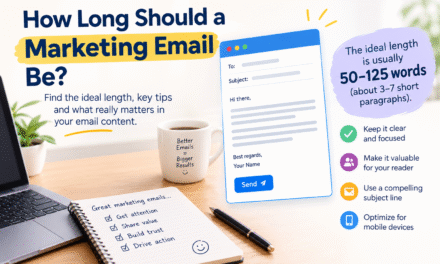
A good marketing email is not simply about selling something. It should give readers a reason to open the email, keep reading, and take action. Whether you are promoting a product, announcing an offer, sharing a blog post, or nurturing leads, the right structure can make your emails much more effective.
In this guide, you will learn how to write a marketing email step by step, with practical tips and examples.
What Is a Marketing Email?
A marketing email is a business email designed to communicate with an audience and achieve a marketing goal.
For example, you might send an email to:
- Promote a product or service
- Announce a special discount
- Share a new blog post
- Introduce a new product
- Invite people to a webinar
- Generate leads
- Encourage existing customers to make another purchase
- Build relationships with subscribers
The goal of every email does not have to be an immediate sale. Some emails are designed to educate or build trust before asking subscribers to buy.
1. Define the Goal of Your Email
Before writing anything, decide what you want your email to accomplish.
Having one clear goal makes the email easier to write and easier for the reader to understand.
For example, your goal could be:
Promote a product:
“Get subscribers to purchase our new email marketing course.”
Generate traffic:
“Get subscribers to read our latest blog post.”
Generate leads:
“Get subscribers to download our free guide.”
Build engagement:
“Ask subscribers to reply with their biggest email marketing challenge.”
Try to focus on one primary action rather than giving readers too many choices.
2. Know Your Audience
The same message will not work for everyone.
Before writing your email, think about who will receive it. Consider their problems, interests, experience level, and goals.
For example, if your audience consists of beginner email marketers, you could focus on simple topics such as:
- How to build an email list
- How to create a welcome email
- How to write better subject lines
- How to improve email open rates
If your subscribers are experienced marketers, you can discuss more advanced topics such as segmentation, automation, personalization, and conversion optimization.
The better you understand your audience, the easier it becomes to create relevant emails.
3. Write a Strong Subject Line
The subject line is one of the most important parts of your email.
It gives subscribers a reason to open the message. If the subject line is unclear or boring, even an excellent email may not get read.
A good subject line should be:
- Clear
- Relevant
- Specific
- Short enough to understand quickly
- Connected to the content of the email
For example:
Weak:
“Important Information”
Better:
“5 Simple Ways to Improve Your Email Marketing”
Other examples include:
- “Want More People to Open Your Emails?”
- “Your Free Email Marketing Guide Is Here”
- “3 Email Mistakes You Should Avoid”
- “A Simple Way to Build Your Email List”
Avoid misleading subject lines. Your subject line should accurately represent what readers will find inside the email.
4. Start With a Strong Opening
Once someone opens your email, the first few sentences need to create interest.
Avoid starting with unnecessary background information. Get to the point quickly.
For example:
“Are you spending time writing emails but getting very few clicks? A few simple changes to your email structure can make a big difference.”
This opening identifies a problem and creates curiosity about the solution.
You can start your email with:
- A question
- A common problem
- An interesting fact
- A short story
- A useful tip
- A direct statement
The opening should make the reader want to continue.
5. Focus on Benefits, Not Just Features
One common marketing email mistake is focusing too much on product features.
Features explain what a product does. Benefits explain how the product helps the customer.
For example:
Feature:
“Our software provides automated email sequences.”
Benefit:
“Create your emails once and automatically send the right message to subscribers at the right time.”
The second version explains why the feature matters.
Whenever you mention a feature, ask yourself:
“Why should my reader care?”
The answer is usually the benefit.
6. Keep Your Email Easy to Read
People often scan emails rather than reading every word.
Make your email easy to consume by using:
- Short paragraphs
- Simple sentences
- Bullet points
- Subheadings
- White space
- Clear formatting
Avoid large blocks of text.
Instead of writing one long paragraph, divide your message into smaller sections.
For example:
Why use email marketing?
- You can communicate directly with subscribers.
- You can personalize your messages.
- You can promote products and services.
- You can build long-term relationships.
Simple formatting makes your email more comfortable to read, especially on mobile devices.
7. Make Your Email Personal
Personalization can make your marketing emails feel more relevant.
The simplest form of personalization is using the subscriber’s name, but personalization can go much further.
You can personalize emails based on:
- Previous purchases
- Content they viewed
- Products they showed interest in
- Location
- Customer type
- Email engagement
- Stage in the buying journey
For example, instead of sending everyone the same product recommendation, you could recommend products based on what a subscriber previously purchased.
However, personalization should feel useful rather than forced. The goal is to make the message more relevant to the reader.
8. Include a Clear Call to Action
Every promotional email should make it clear what the reader should do next.
This is called a call to action (CTA).
Examples include:
- Read the Full Guide
- Download the Free Ebook
- Start Your Free Trial
- Get the Discount
- Watch the Tutorial
- Book a Demo
- Learn More
A good CTA is specific and action-oriented.
Instead of:
Click Here
try:
Download Your Free Guide
The second CTA tells readers exactly what will happen when they click.
9. Create a Sense of Value
People receive many emails every day. Your message needs to provide a reason for them to pay attention.
Think about what value you are offering.
You might provide:
- A useful tip
- Educational information
- A free resource
- A special discount
- Early access
- Exclusive content
- A solution to a problem
For example, rather than simply saying:
“Buy our email marketing course.”
You could say:
“Learn how to build your first email campaign, create automated sequences, and turn subscribers into customers with our beginner-friendly course.”
The second approach explains the value of the offer.
10. Use a Conversational Tone
Marketing emails don’t have to sound like formal business documents.
Write as though you are having a conversation with one person.
Instead of:
“We are pleased to announce that our company has introduced a new product.”
Try:
“We’ve just launched something new that can make your email marketing easier.”
A conversational tone can make your emails feel more personal and approachable.
Use simple language and avoid unnecessary jargon.
11. Create Urgency When Appropriate
Urgency can encourage people to take action, but it should be genuine.
For example:
- “Offer ends Friday.”
- “Early-bird pricing ends tonight.”
- “Registration closes tomorrow.”
If an offer really has a deadline, communicate it clearly.
Avoid creating fake urgency. Constantly telling subscribers that an offer is “ending today” when it never actually ends can reduce trust.
12. Add Social Proof
Social proof can help reduce uncertainty and increase confidence.
You can include:
- Customer testimonials
- Reviews
- Ratings
- Case studies
- Number of customers
- Success stories
For example:
“More than 5,000 marketers have used our guide to improve their email campaigns.”
If you use statistics or testimonials, make sure they are accurate and genuine.
13. Make Your Email Mobile-Friendly
Many people read emails on smartphones.
Your email should therefore be easy to read on a small screen.
Keep these points in mind:
- Use short paragraphs.
- Make links easy to tap.
- Avoid overly complicated layouts.
- Use readable text.
- Make your CTA clearly visible.
- Test how the email looks on mobile devices.
A beautiful desktop email can still perform poorly if it is difficult to read on a phone.
14. Proofread Before Sending
Before sending your marketing email, check it carefully.
Look for:
- Spelling mistakes
- Grammar errors
- Broken links
- Incorrect product information
- Missing images
- Incorrect personalization
- Confusing sentences
- Weak CTAs
Read the email from the subscriber’s perspective.
Ask:
“Would I want to read this email?”
You can also send yourself a test email before sending it to your entire list.
Example of a Marketing Email
Here is a simple example for an email marketing blog or business:
Subject: Want More People to Read Your Emails?
Hi,
Are your emails getting opened but not generating enough clicks?
The problem may not be your email list. Your message, offer, or call to action could need some improvement.
Here are three simple things you can try:
- Write a subject line that creates curiosity.
- Focus on the benefits your reader will get.
- Use one clear call to action.
Small changes can make your emails easier to understand and more engaging.
Want to learn more?
Read our complete guide to improving your email marketing.
Keep testing, learning, and improving your emails.
Best,
Raghava
Common Marketing Email Mistakes to Avoid
Even a well-written email can perform poorly if you make a few common mistakes.
Writing Only About Yourself
Your subscribers are interested in their problems and goals, not just your company.
Focus on how your product, service, or content can help them.
Using Too Many CTAs
Giving readers several different actions can create confusion. Choose one primary action whenever possible.
Making the Email Too Long
Long emails are not automatically bad, but unnecessary information can reduce engagement. Remove anything that does not support your main goal.
Using Clickbait Subject Lines
A subject line that makes a promise your email does not fulfill can damage trust.
Ignoring Your Existing Subscribers
Don’t communicate with subscribers only when you want to sell something. Share useful information regularly and build a relationship.
Final Thoughts
Learning how to write a marketing email is about more than putting words together and adding a “Buy Now” button. A successful email starts with understanding your audience and defining a clear goal.
Write a subject line that encourages the right people to open the email. Start with a strong introduction, explain the benefits, provide useful information, and finish with a clear call to action.
Most importantly, keep testing your emails. Experiment with different subject lines, openings, offers, CTAs, and content. Track your results and use what you learn to improve future campaigns.
With consistent practice, you can create marketing emails that not only promote your business but also provide real value to your subscribers and build long-term customer relationships.






Your writing style is so engaging and easy to read It makes it a pleasure to read your blog and…
I was more than happy to search out this net-site.I needed to thanks for your time for this excellent learn!!…
Usually I do not read article on blogs, but I would like to say that this write-up very compelled me…
Hello, i believe that i noticed you visited my website thus i came to “return the choose”.I'm attempting to find…
Thanks for sharing. I read many of your blog posts, cool, your blog is very good.